
The Curious Case of Universal Genève, UWECO, and Berthoud Genève
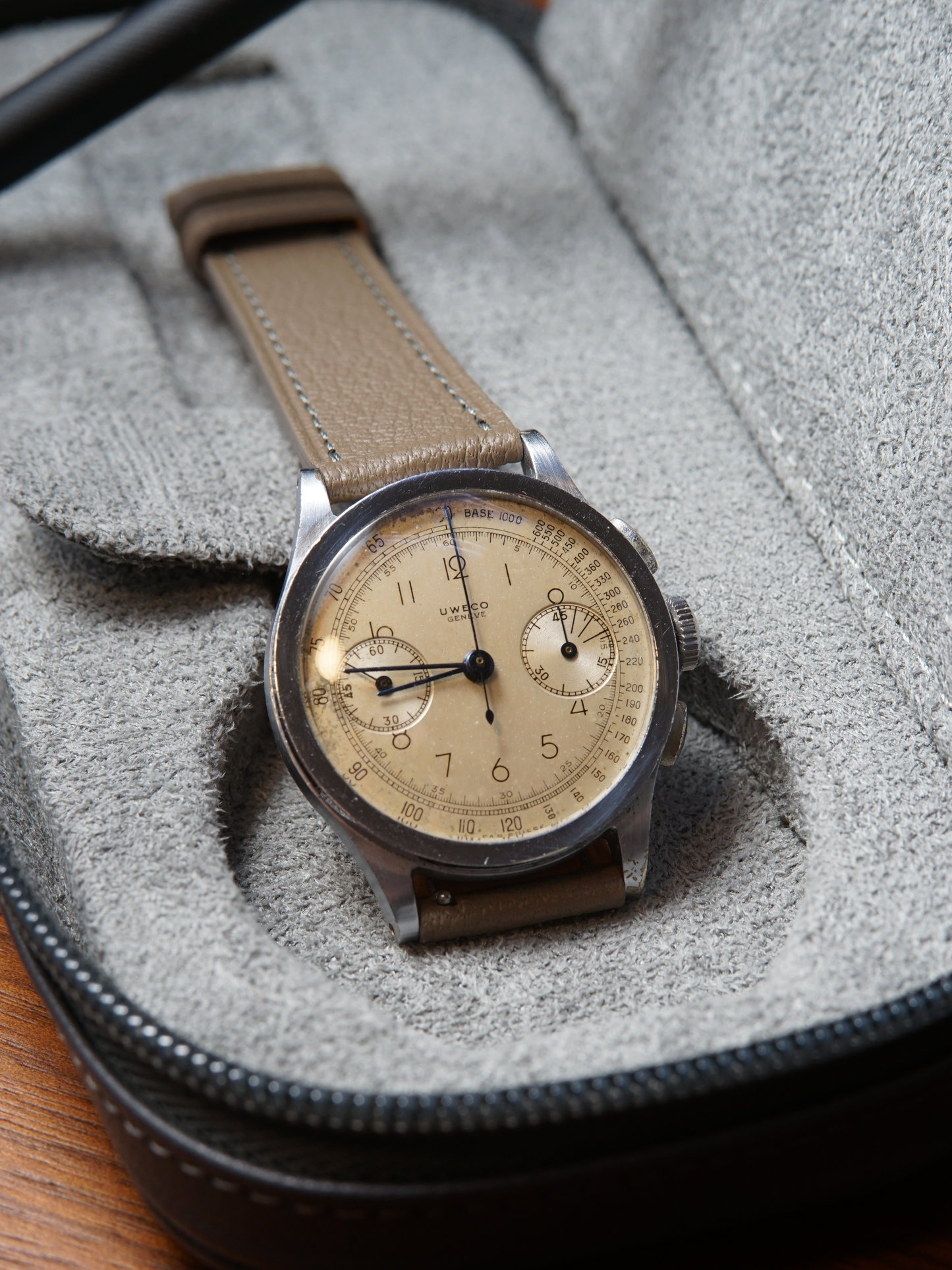
UWECO is a historical trade name that comes directly out of Universal Genève’s own corporate evolution, and a 1940s UWECO Genève bi‑compax chronograph with Cal. 385 is essentially a Universal in everything but a change in dial signature.

UWECO and Universal Genève
Universal Genève began in 1894 as “Universal Watch,” founded by Numa Descombes and Ulysse Perret to manufacture complicated watches and chronographs. After Descombes’ death, Perret partnered with Louis‑Édouard Berthoud and the company name evolved from “Perret & Berthoud” to “Universal Watch Et Company (UWECO) Genève Ltd.”, which is where the UWECO abbreviation originates。

Image taken from: https://universalgeneve.info/content/17-logos
“UWECO” (Universal Watch Et COmpany) was later registered and used as a sub brand and trade name within the Universal umbrella, appearing on dials and paperwork while the underlying legal entity and product engineering remained Universal. Period documentation and surviving watches show UWECO mainly on 1930s–40s pieces, often chronographs, aimed at specific markets (e.g. Japan) or lower price points but using the same in‑house chronograph design as Universal‑signed Compur and Compax references.

An advertisement from the 1954 The Horological Institute of Japan Magazine positions "Universal" (ウニバーサル) and "UWECO" (ウエコ) as two different brands, highlighting Universal Genève's strategic market segmentation. (my own magazine collection)
A 1940s UWECO Genève bi‑compax chronograph with Cal. 385 sits squarely in this context: the design language (bi‑compax layout, 35–38 mm steel case, olive pump pushers) and movement architecture are pure Universal, while the UWECO dial and case back engraving reflect a different brand segmentation rather than a different manufacturer.

Berthoud Genève’s role in Chronograph Development
Louis‑Édouard Berthoud’s entry in 1897 formalised the “Perret & Berthoud” partnership, which took over the patents and sub‑brands of Universal Watch and pushed the firm deeper into complete chronograph production. Under Berthoud’s influence, Universal consolidated expertise in integrated chronograph design, leading from early pocket chronographs (such as Universal Watch Extra) to wrist chronographs in the 1910s and, ultimately, to the 1930s Compur and Compax models.

Image taken from: https://universalgeneve.info/content/6-history
“Berthoud Genève” subsequently appears not only as a historical partner name but also on mid‑century casebacks and dials, effectively functioning as an associated brand through which Universal sold chronographs in parallel to its own Universal / UWECO signatures. Many Berthoud‑signed chronographs house Universal’s in‑house chronograph calibres (281/285/385/287 etc.), meaning a Berthoud Genève bi‑compax on Cal. 385 is best understood as a Universal Compur/Compax‑grade product delivered through an alternative branding strategy.

A UWECO dial with Berthoud Genève caseback on a Cal. 385 movement essentially triangulates to “Universal Genève chronograph, Compur/Compax family, sold under sub‑brand signatures,”
Cal. 285 vs Cal. 385
Both Cal. 285 and Cal. 385 are lateral‑clutch, column‑wheel chronographs developed by Universal, designed as the main movement for Compur, Compax and their derivatives. They share the same basic architecture and dimensions (around 31.7 mm diameter, roughly 6.05 mm thick, 18,000 vph) and could be configured with 30‑ or 45‑minute counters in bi‑ or tri‑compax layouts.

The key technical difference is the hairspring: Cal. 285 uses a Breguet overcoil hairspring, whereas Cal. 385 uses a flat hairspring. Functionally, both calibres deliver similar chronograph performance, but Cal. 285 is usually regarded as a more premium counterpart of 385, using the same structure while opting for the more labour‑intensive overcoil for a flat spring. A Breguet overcoil hairspring is supposedly more efficiently than a flat spring, which (theoretically) contributes to less positional error and hence, better accuracy in all of the positions.

Image taken from: https://reference.grail-watch.com/family/universal-285/
For a UWECO / Berthoud bi‑compax, a correctly signed Cal. 385 thus signals a late‑1930s to 1940s Universal chronograph built to Compur/Compax design and specifications, with the subtle technical difference in the hairspring that distinguishes it from earlier 285‑equipped pieces.