
A Deep Dive into Japan’s First Triple Calendar | Citizen Ref. 1505
The 1952 Citizen Triple Calendar Ref. 1505 is Japan’s first triple calendar watch. This model is significant for its technical architecture, design language, and the way it positioned Citizen within the market that was still dominated by Swiss manufacturers. Today, it occupies a small but important niche in vintage collecting, especially for those who focus on Japanese complications.

Postwar Japan and Citizen’s Technological Leap
In the early 1950s, Japan’s watch industry was still recovering from World War II, gradually evolving from simple time only pieces to more complex mechanical designs. Citizen introduced Japan's first triple calendar wristwatch in 1952, aiming to compete with more advanced watchmaking internationally.

Photo from: https://vintagecitizenwatches.com/wp-content/uploads/2015/04/citizen-triple-calendar.jpg
A triple calendar or complete calendar mechanically displays the day of the week, the month, and the date, using a system of gears, star wheels, jumpers, and springs. Packing all these functionalities into a compact 33mm wristwatch required detailed design, tight tolerances, careful engineering, and a deep understanding of kinematics and wear over time.
A Dedicated Calendar Plate
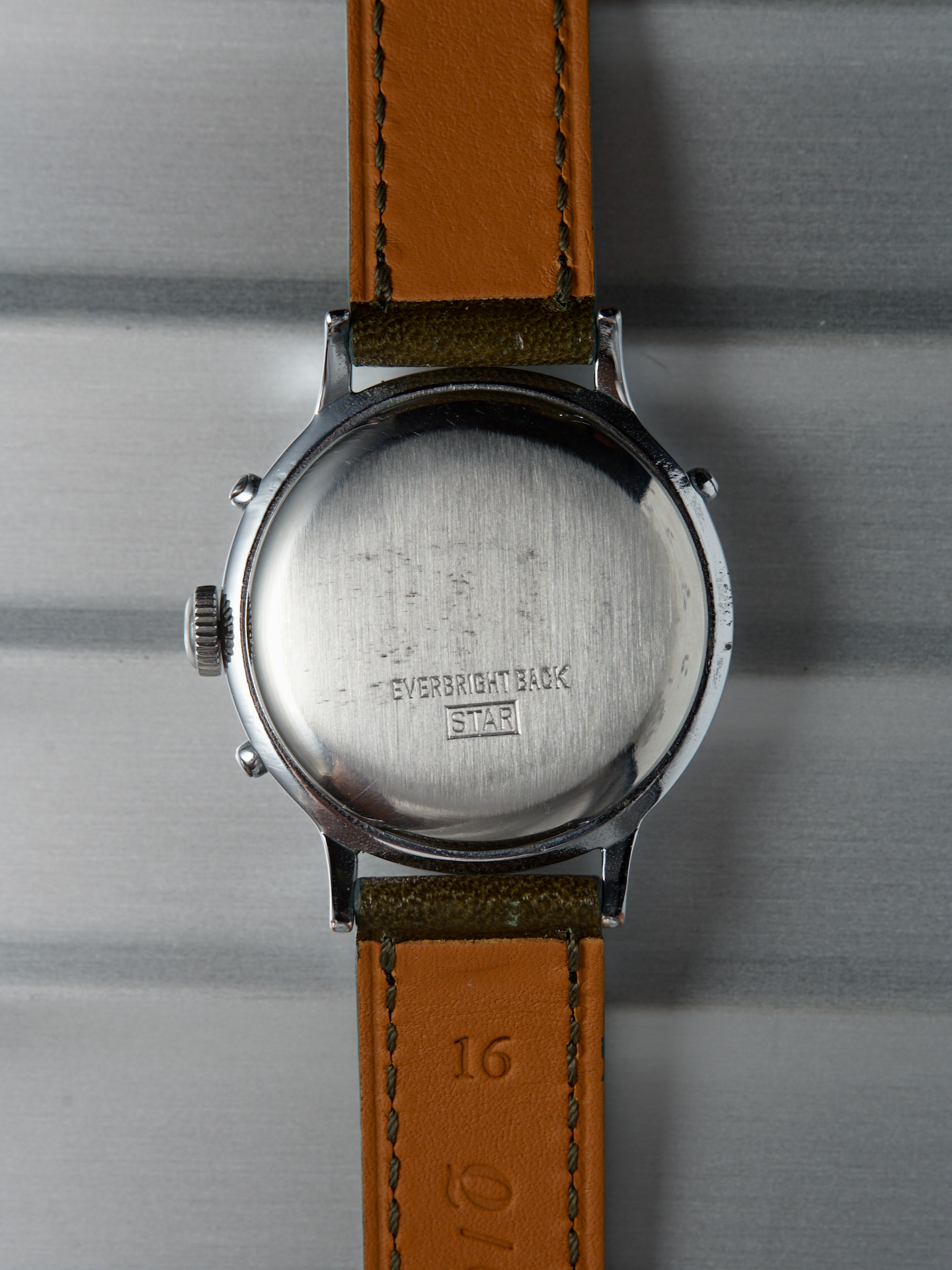
When you open the case back, you'll see a simple baseplate layout similar to that of a time only, that is because the Citizen Triple Calendar uses a hand-wound base movement (Caliber 59) with a dedicated calendar plate added to the dial side. This add on calendar plate is similar in concept to other Swiss triple calendars, where a relatively simple time only movement is upgraded by a separate calendar layer that drives day, date, and month indications.

- The base movement runs at 18,000 vph (5 beats per second), consistent with early 1950s engineering priorities that favoured stability and lubrication over high frequency.
- The calendar plate contains star wheels for day, date, and month, each held in position by polished jumper springs that control the click and ensure that indications land cleanly in their respective windows or along the date track.
The 31‑tooth date star wheel is driven via a date jumper wheel pinned to the date wheel, with about 0.2 mm of clearance between the pin and its hole. This allows the star to be pushed part way by the slow turning drive wheel and then snapped the rest of the way by the jumper spring, ensuring crisp, reliable advancement and reducing the risk of jamming.

The manual also specifies a critical minimum clearance of around 0.03 mm between the driving claw and the adjacent tooth at closest approach. If the gap is too wide, the date may not fully advance; if too tight, the mechanism risks double-advancing, jumping two days instead of one.
Day and Month Indications
The weekday is displayed via a 7 tooth weekday wheel driven by a pin on the weekday wheel, which makes one full rotation per day. A spring loaded retainer (weekday jumper) locks each tooth in place between jumps, ensuring that the day indication aligns correctly in the dial window.

The month star wheel, with 12 teeth corresponding to the 12 months, is advanced only manually via a pusher/lever system, rather than automatically. This reflects the practical reality that months vary in length; a fully automatic system would require much more complex logic, approaching an annual or perpetual calendar, which would have been too ambitious and costly in early 1950s Japan.
Design Language and Dial Details
Swiss Influence, Japanese Identity
The Citizen Triple Calendar showcases a mix of 1950s Swiss influence and a distinctly Japanese design aesthetics.
- Applied gold hour markers and raised Citizen “C” logo give the dial a more premium look (on later variant)
- The subtle use of gold metal around month and day windows frame improve the legibility on a rather busy dial (on later variants)
- The minute hand with a curved tip, a feature borrowed from Swiss dress watches that demonstrates Citizen’s attention to usability around the issue of parallax caused by curved crystal around the edge.
- The outer date track is printed in a contrasting light blue colour while the text of month and day is black text printed on yellow background. These subtle details feel modern and slightly technical for its time - an interesting choice of colour on a high end dress watch while adding functional complexity and legibility.

Domestic vs Export Dials
One of the most charming and collectible aspects lies in the language variation of Month and Day of Week indicator.
-
Domestic-market versions use Japanese text for the month and day of week displays, clearly intended for buyers within Japan.
-
Export pieces typically show this information in English, aligning with international expectations and improving legibility for overseas collectors.
For collectors, Japanese‑text examples are often more intriguing, as they were produced for the domestic market. Interestingly, overseas variants with English calendar wheels appear to be less common based on my observations.
Case, Dial and Movement Variations
The Citizen triple calendar watches measures roughly 33 mm in diameter with a 17 mm lug width (16 mm on earlier variants, dimensions typical of the early 1950s dress aesthetic. While small by modern standards, this sizing often wears larger than the numbers suggest, thanks to thin bezels and relatively long lugs.

Citizen triple calendar watches come in several variations, available in both stainless steel and 14k gold-filled cases. These can be broadly classified into three series: first, second, and third series, distinguished primarily by movement construction, case design, and calendar text language.
Series Differences
Movements in the first and second series feature 16 jewels, while the third series uses 17 jewels, providing an initial clue for identification. From the movement side, first and second series cases show cutouts for the pushers; only the first series has Geneva stripes, whereas second and third series movements have simpler brushed finishes.

Calendar Features
First series pushers protrude more prominently than those in later models. Its month and day wheels use white backgrounds with English text only, while second and third series introduce yellow backgrounds with bilingual Japanese and English text. Only the third series have gold metal frames around the month and day wheels.

Price and Social Context at Launch
When new, the Citizen Triple Calendar sold for about 4,170–5,370 yen, at a time when the average monthly salary of a new university graduate was around 3,000 yen. This placed the watch firmly in the luxury category.
The combination of mechanical complexity, gold‑filled cases prone to wear, and 70 years of history means that well‑preserved examples are genuinely scarce today.
Choice of Strap
To complement the 14k gold-filled case, I’ve chosen a brown nubuck strap with a suede-like texture and light brown full stitching.

Why This Watch Matters Today
The Citizen Triple Calendar showed that Japanese watchmakers could compete with Swiss brands not just in reliability and design, but also in mechanical complexity. This model blends Swiss influenced styling with Japanese practicality, seen in the hands and the unique calendar layout.
For collectors today, especially those interested in Japan’s early watch history, the Citizen Triple Calendar is an important piece to know.