
Three Unusual Vintage Doxa Watches Beyond the SUB 300 Dive Watches
A different Doxa than most collectors know
Today, Doxa is synonymous with the famous orange dial SUB 300T and the rise of purpose built dive watches in the late 1960s. But before that, the Doxa brand had already built a reputation for robust movements, technical patents, and high‑grade complications that placed it in the same industrial ecosystem as Zenith, Ulysse Nardin, and H. Moser & Cie. This article will talk about Doxa's some less well known designs and complications rather than diving into its history in waterproof watches.
Founded in 1889 by Georges Ducommun, Doxa quickly stood out in pocket watches by patenting an 8-day movement tailored for automotive dashboards (see a more detailed video: https://www.youtube.com/watch?v=El2auA9ekqU). These clocks were installed on early Bugattis in the 1900s, demanding shock resistance and long reserves in harsh road conditions, much like today’s IWC-Mercedes or Jacob & Co.-Bugatti partnerships, though Doxa targeted a far more practical audience.
Doxa’s modern fame rests on purpose built dive watches, but that ethos traces straight back to these function-first dashboard clocks and other vintage tool watches, crafted for specific users with unyielding precision in mind.
#1 Doxa Ref. 15000 "Instaneous Second" and it's timing function
The first watch to highlight is this Ref. 15000 from the 1960s. A vintage advertisement brought this watch to my attention. At first glance, it appears to be a simple time-only three-hander. However, it houses a deadbeat movement that advances the second hand like a quartz watch.


Photo credited to Beyer: https://www.beyer-ch.com/en/watches/pre-loved-watches/detail/doxa-10005221/
What's little known, and rarely mentioned by other vintage dealers, is that the crown serves a second purpose beyond time setting. When you push the crown in, it stops the second hand while the movement continues running. Releasing the crown lets the second hand resume. This ingenious mechanism lets users halt the second at 12 o'clock, then release it to time events precisely, without estimating start and stop positions for intervals. It also functions as a hacking seconds mechanism, allowing the hand to stop and restart at exactly zero seconds for better time accuracy.
#2 Doxa Sfygmos Pulsometer Monopusher Chronograph
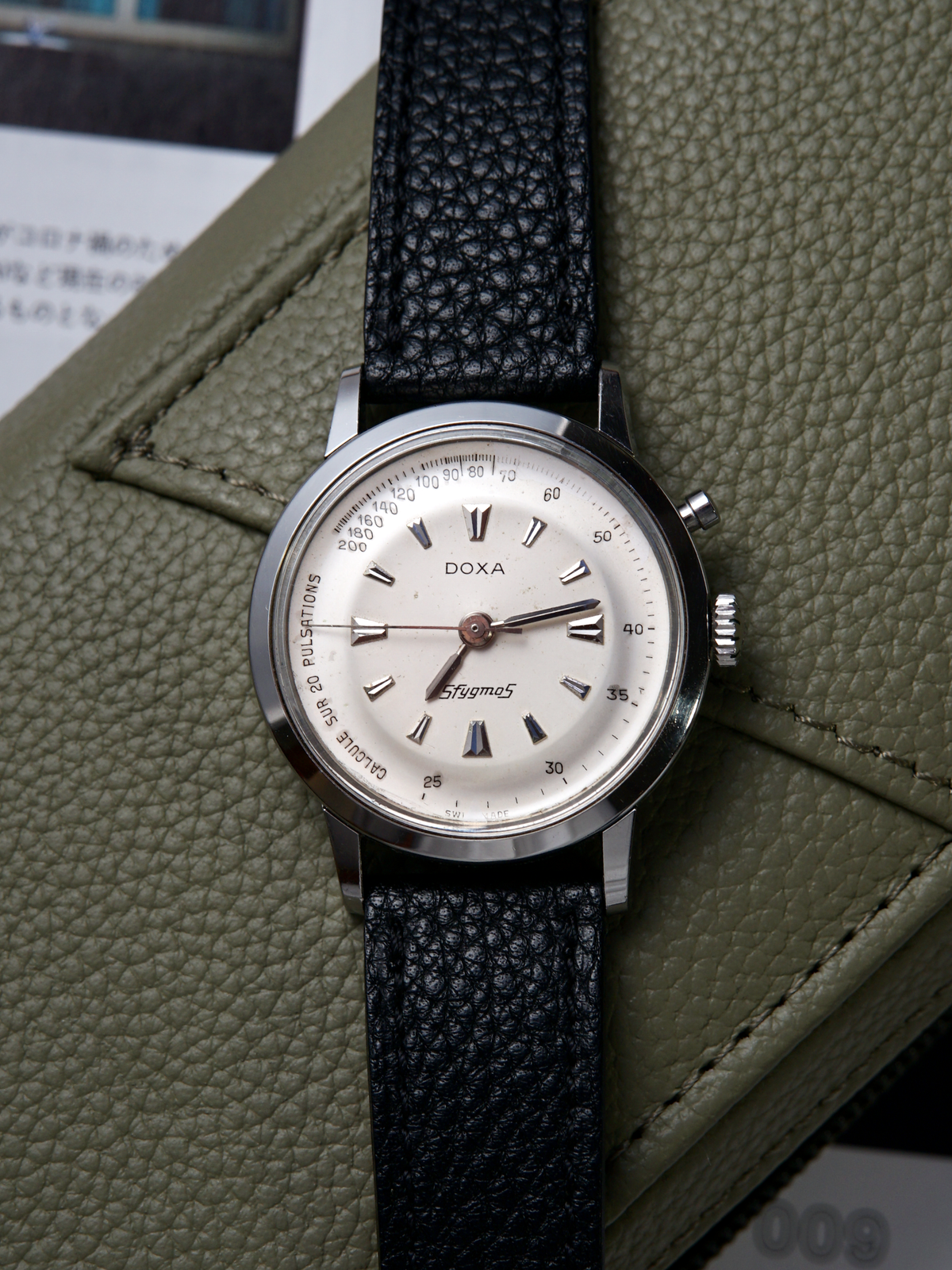
The second Doxa that grabs my attention is the Sfygmos - a rare mid-century medical chronograph named after the Greek word for “pulsation,” built for doctors timing pulses with one hand. The single pusher at 2 o’clock handles start, stop, and reset with one finger, freeing the other for a stethoscope during exams. This single-handed layout sets it apart from most vintage chronographs of its era. The typography seals the deal: “Sfygmos” is rendered in a retro-futuristic italic font that draws the eye.


Even more unique is its circular magnifier over the pulsation track: an internal ring-shaped “cyclops” sits beneath the crystal, encircling and amplifying the markings. This under-crystal feature emphasizes the outer ring while keeping central hours crisp and clean, creating a striking three-dimensional look without a multi-part dial.


Instead of the usual 12 o’clock reset, the Sfygmos starts and returns its chronograph seconds hand to 9 o’clock. Inside, it’s powered by the Valjoux 23, a hand-wound, column wheel movement that’s a benchmark of mid-century design. Known for precise actuation, robust construction, and enduring reliability, this movement powered many respected brands and remains a collector favourite today.

#3 Doxa Grafic
The third model shifts focus from mechanisms to striking case and dial design which is rather unusual for Doxa, where purpose driven engineering typically steals the spotlight. This might mark the brand’s earliest push into the women’s market, with distinct men’s and women’s variants. The date window sits unusually at the top-left corner, balanced by the Doxa logo in the bottom-right; meanwhile, the dial’s crisp array of straight lines evokes a clean Bauhaus aesthetic.

----
Doxa’s vintage lineup likely holds even more intriguing models yet to be discovered. When you come across one, don't let it slip away.