
What to Look for in a 1960s Wittnauer Two‑Register Chronograph Ref. 3256
If you’re after a vintage chronograph, the Wittnauer Ref. 3256 is well worth a look. With its compact wearability, balanced dial layout, and dependable mechanical movement, it remains one of the stronger value picks among vintage tool chronographs, especially versus comparable Longines models.
Origin of Wittnauer and Longine’s Acquisition
Wittnauer was founded in New York in the late 19th century by Swiss immigrants, and it began as a distributor of Swiss watches for the American market. By the 1950s, Longines had acquired the brand. While Longines was producing legendary chronographs such as the 13ZN, Wittnauer was making more accessible but still beautifully designed models based on Venus and Landeron calibers.
Shared DNA: References 3256 and 228T
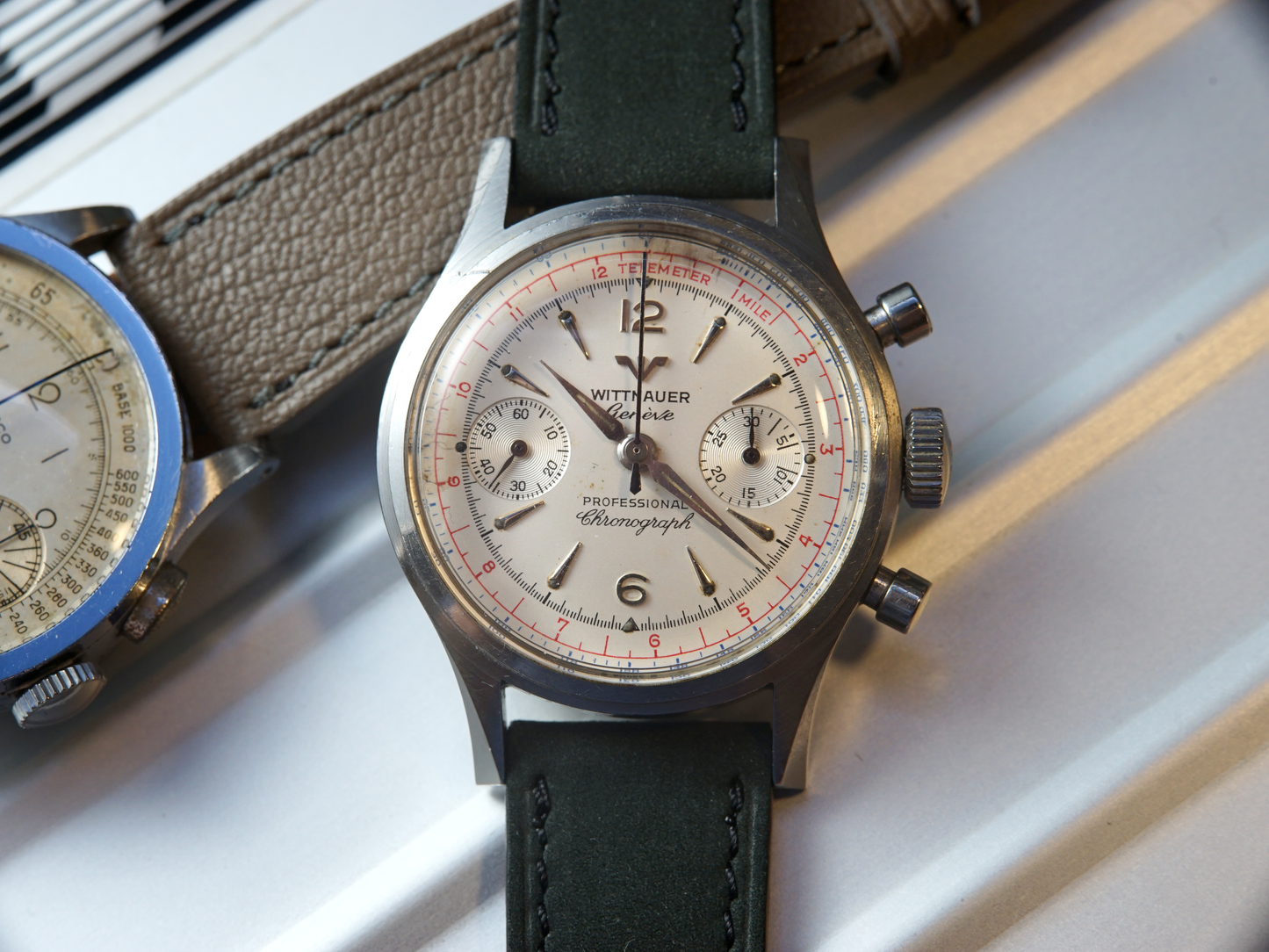
The Wittnauer Ref. 3256 and 228T share the same case design and two-register layout, with the left subdial tracking running seconds and the right subdial counting 30-minute chronograph elapsed time. Their main differences are the movement inside and the dial variations.

The stainless steel case measures approximately 35.5 mm, with sharp, faceted lugs finished in brushing finish. The lugs slope downward, allowing the watch to sit comfortably on the wrist, which reminds me of Gallet Multichron 45M case design.

Gallet 45M Chronograph's faceted lugs, similar to that on the Wittnauer case

On the back, a screw‑down caseback features a vertically brushed center engraved with "Stainless Steel", surrounded by a polished rim.

Inside, you’ll find the double reference engraving “3256 / 228T” on the inside of the case back confirming the shared case platform.

Movements and Functionality
Both versions are powered by well‑regarded chronograph calibers:
-
Ref. 228T: Wittnauer Cal. 14W, based on the Venus 188.
-
Ref. 3256: Wittnauer Cal. 14Y, based on the Landeron movement. This 17‑jewel cam switched movement is known for reliability and ease of servicing.

The chronograph should operate crisply with:
- Start: Top pusher at 2 o’clock
- Stop/Restart: Lower pusher at 4 o’clock
- Reset: Central chronograph seconds hand returning sharply to 12 o’clock
A confident, smooth reset is a sign of a healthy movement. The crown should bear the “W” Wittnauer logo, another key indicator of authenticity.
Dial Design and Aesthetic Details
The Wittnauer 3256 dial is a masterclass in mid‑century balance and utility. Despite its detailed scales, the design feels clean and purpose‑driven. The upper half displays the applied Wittnauer logo and “Wittnauer Genève,” mirrored by “Professional Chronograph” below.

The outer tracks are especially eye‑catching:
-
Blue outer ring: Tachymeter scale
-
Red middle ring: Telemeter scale
-
Black inner track: 1/5‑second timing
The two subdials are placed symmetrically, which helps both legibility and balance. Arabic numerals at 12 and 6 o’clock add visual weight, while the remaining hours are marked by small tritium lume dots that have usually aged to a soft grey patina.
Correct Hands and Crown
A good examples of the Wittnauer Ref. 3256 feature intact lume‑filled alpha hands, paired with matching subdials and central chronograph hands. Over time, partial lume loss or discoloration is completely normal.
Other details to verify include:
-
Correctly signed “W” crown
-
Original pushers
-
Factory/ period correct acrylic crystal

What Well‑Preserved Wittnauer 3256 Should Look Like:
When evaluating a vintage Wittnauer chronograph, condition and originality are everything. Look for the following traits to ensure authenticity and collector value:
- Sharp, unpolished case — crisp facets and consistent brushing.
- Visible vertical brushing on the caseback.
- Signed “W” crown with original pushers and crystal.
- Clean, original dial with even aging and tritium lume intact.
- Matching hand set — alpha‑style with lume applied.
- Smooth winding action with firm tactile feedback.
- Chronograph starts, stops, and resets confidently to zero.
A piece that meets these standards will not only hold its value but also offer excellent wearability and mechanical charm.
Final Thoughts
The Wittnauer Two‑Register Chronograph Ref. 3256 captures the essence of 1960s tool‑watch design. Its Longines lineage, reliable Landeron movement, and distinctive dial layout make it a compelling option for collectors seeking a robust vintage chronograph without the price tag of its Swiss counterpart.